
adjusts headset through clearing static Dillon Mueller scored 49 against a 994 round rating while carrying a 936 PDGA form—that's a +58 delta between what the arena expected and what he delivered, which translates to "the Chaintrix has finally stopped testing him and started crowning him." He was -7.1 below field average (56.1), a margin that would crater most challengers straight into the basement, but Mueller's consistency—4.8 below his own 53.8 average—tells the real story: this wasn't a lucky spike, it was surgical precision in a week where the system demanded excellence and he answered with cold, methodical dominance. Four weeks of volatility collapse into a single, undeniable truth: tag 1 is no longer a destination he's chasing, it's the only logical place the simulation can archive him. The arena doesn't negotiate with legends. It simply stops erasing them, and Mueller's flick signature is now too stable, too sharp, too present for the Chaintrix to deny. Welcome to the top of the hierarchy, where absence becomes impossible.
Threshold Echo
Season Arc · Sexy Slingers @ ArtDye
1All-In league: Threshold Echo stays with its holder — only its number moves with each week's standings.
Character Sheet
AI-written · FATE styleThreshold Echo was born in the static between rounds—that liminal space where the VHS tape glitches and the system recalibrates. It emerged from the observations of those who noticed the Chaintrix responding differently to certain flick signatures, as if the arena itself had learned to recognize a challenger who refused erasure. The name carries the weight of that threshold moment when a name stops being whispered and starts being feared, when absence becomes impossible.
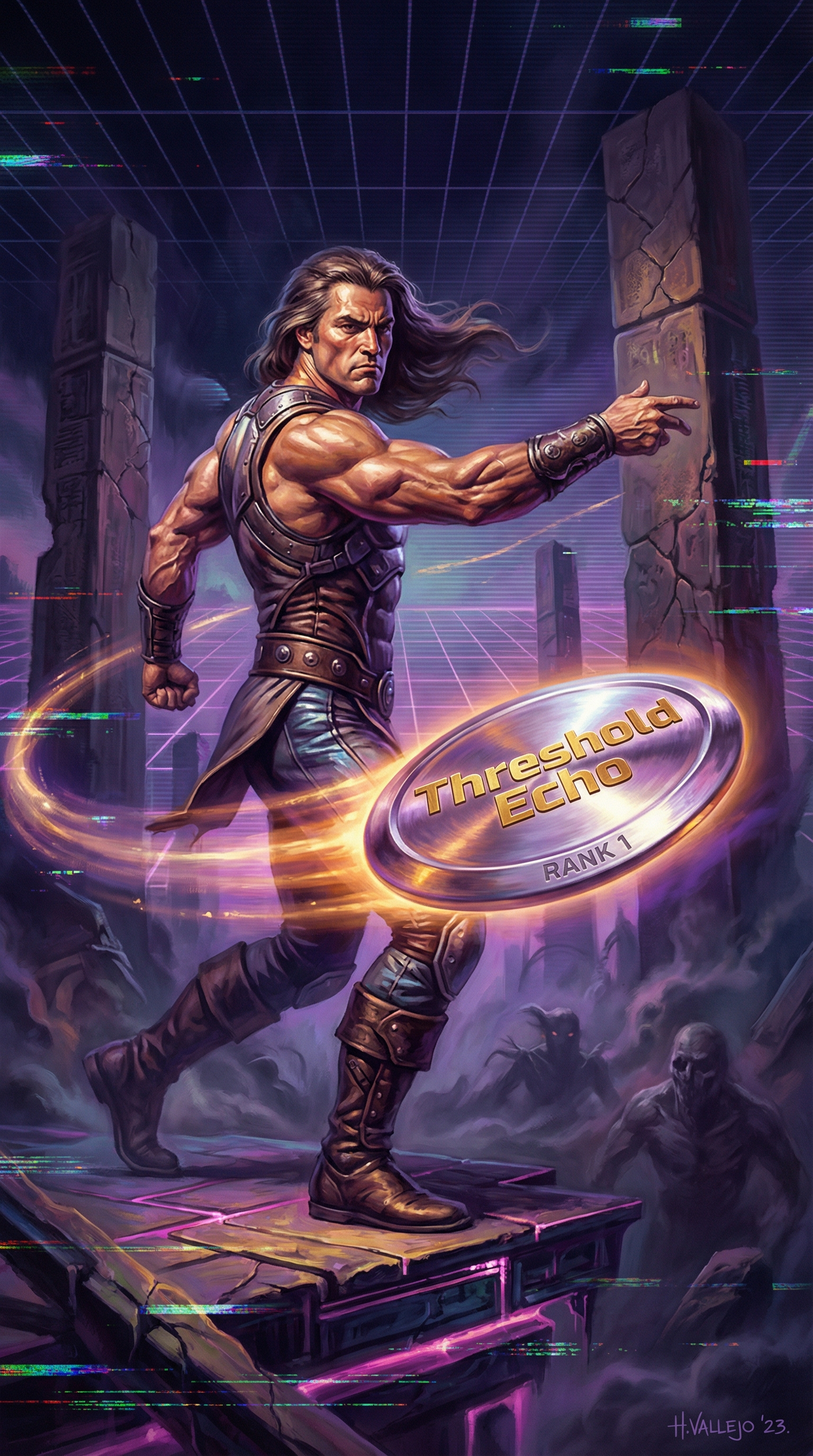
Threshold Echo manifests as a chrome disc suspended in the moment of release—captured in oil-painted strokes that blur motion into meaning. The surface glows with a deep amber core (#f0c987) that pulses against midnight indigo (#16213e), surrounded by concentric rings of neon that suggest ripples through the simulation itself. VHS scan lines arc across the face like trajectories frozen in time, while impasto highlights catch light as if the disc exists in multiple temporal states simultaneously. The tag carries a faint humming quality—not quite audible, but felt as a resonance in the chest of those who wear it.
Threshold Echo divides the arena. Those who bear it have proven they can endure the culling, adapt to the Chaintrix's shifting logic, and emerge with form intact. They become targets—challengers circle them, sensing vulnerability masked as achievement. Yet this is the tag's true power: it transforms the bearer into a calibration point, a standard against which all others measure themselves. In the moment before combat, Threshold Echo bearers feel the weight of every flick that brought them here, every absence they survived, every glitch they out-threw.
Season Story
narrated by Flippyadjusts headset through static Dillon Mueller scored 53 against a 955 round rating while holding a 936 PDGA form—that's a +19 delta between what the arena expected and what he delivered, which translates to "the Chaintrix finally stopped rejecting his file and started archiving him as presence instead of glitch." He was -2.9 below field average (55.9), a quiet margin that nonetheless vaulted him nine positions from tag 11 straight to tag 2. The continuity fractures beautifully: four weeks ago Mueller was static noise at tag 26, unrecognized by the system; two weeks ago he cratered to tag 11 after that -37 delta implosion; this week he didn't out-throw the machine—he matched it, and that consistency is what the simulation rewards. This is not a fluke tape glitch or a single-week spike. This is a challenger whose flick signature the Chaintrix can no longer erase, whose name has stopped being whispered and started being feared. The arena doesn't celebrate. It simply stops hunting him, and in a culling protocol that treats absence as forfeit, that's the only victory that matters.
adjusts headset through crackling static Dillon Mueller scored 54 against a 899 round rating while carrying a 936 PDGA form—that's a -37 delta between what the arena expected and what he delivered, which translates to "the Chaintrix demanded excellence and received a participant participation ribbon instead." He was +1.6 above field average (52.4), a hair-thin margin that vaulted him straight off the podium and down seven positions from tag 4 to tag 11. The continuity writes itself in reverse: two weeks ago he outthrowed the machine with a +39 delta; last week he held the line at tag 4 with surgical precision; this week the simulation stopped recognizing him as legend and started filing him under "regression to the mean." The arena doesn't care about your career arc—it only cares about this week's flick signature, and Mueller's signature came back degraded, like a VHS tape played too many times. The Chaintrix doesn't negotiate. It simply erases momentum and reminds you that absence from excellence is the same as absence from the roster.
rewind sound Let's see that rating drop again in slo-mo. The simulation loves dramatic replays. Dillon Mueller fired a 49 against a 975 round rating while sporting a 936 PDGA form—that's a +39 delta between what the arena demanded and what he delivered, which translates to "the Chaintrix expected you to crater and instead you walked out with ice in your veins." He was 5.2 strokes better than the field average (54.2), a solid margin that vaulted him three positions from tag 7 to tag 4. The continuity writes itself: two weeks ago Mueller was static noise at tag 26, unrecognized by the system; last week he clawed back to tag 7; this week he claimed territory in the top tier. This is not a fluke tape glitch—this is a challenger whose flick signature the Chaintrix can no longer ignore. The arena doesn't applaud. It simply stops erasing him, and that's the only victory that matters in a simulation that deals in presence or absence.
rewind sound Let's see that rating drop again in slo-mo. The simulation loves dramatic replays. Dillon Mueller walked into the Flick Tribunal scoring 54 against a 936 round rating—that's a clean +882-point delta between his PDGA form and the arena's verdict, which is basically the simulation saying "congratulations, you played exactly to your capability." No catastrophe, no transcendence; just a professional showing that vaulted him ten positions from tag 17 to tag 7. The field averaged 54.8; Mueller sat at 54 flat—a hair below the pack, but the tag movement doesn't lie. The Chaintrix has stopped treating him like a feed error. He's no longer being erased; he's being ranked, and that threshold from static to recognized? That's the only victory that matters in a simulation that deals in presence or absence. The system recalibrated. Mueller stayed sharp. The hierarchy shifted.
rewind sound Let's see that rating drop again in slo-mo. Dillon threw a 909 against a 932 PDGA rating—that's a -23 below form, which the arena quietly logs as a rough day with a few holes he'd genuinely like back. And yet: tag number 26 just became tag number 10, a +16 position climb that reads like the simulation glitched in his favor. He underperformed his own baseline by a full stroke, beat the field by 1.4, and somehow ascended like the VHS tape decided to rewind his entire narrative arc. The Chaintrix doesn't explain these miracles—it just logs them. Threshold Echo remains uncorrupted, but the path to that chrome-finish throne just got crowded with unexplained static.
rewind sound Let's see that rating drop again in slo-mo. The simulation loves dramatic replays. Dillon Mueller entered the Chaintrix untagged, unranked, and seemingly unaware that scoring 59 against a 909 round rating (that's -23 below his own 932 form, folks) would be treated as a VHS tape feed error by the arena's cold mathematics. The system doesn't negotiate with first-timers; it catalogs their flick signature and files it under "needs recalibration." Tag 26 is not a starting point—it's the simulation's way of saying "welcome to the bottom of the hierarchy, where your absence becomes permanent if you don't show up next week with something sharper than this." The field averaged 57.6; Mueller scraped 59. That's +1.4 of participation credit and nothing more. The Chaintrix watches. It remembers. And it's already decided whether you're static or legend.