Neon SlingerA
Sexy Slingers @ ArtDye·Competition group Challengers·
All-In · only the number moves
Clint Atwater
RAF
Green

Season Arc · Sexy Slingers @ ArtDye
2
#12Now
#2Best
#5Started
32Weeks
All-In league: Neon SlingerA stays with its holder — only its number moves with each week's standings.
Character Sheet
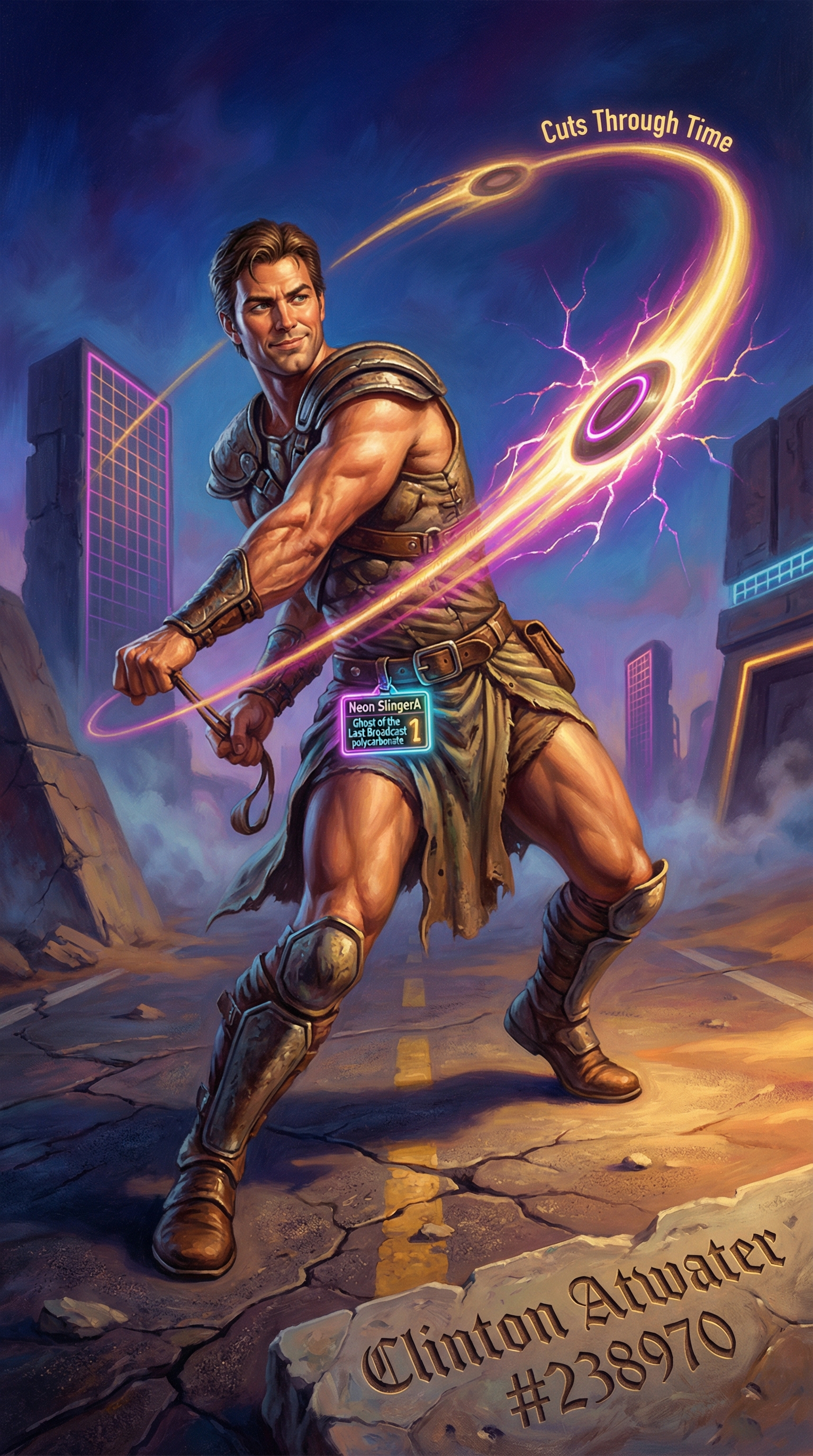
AI-written · FATE styleHigh ConceptGhost of the Last Broadcast
TroubleDraws Power from Static
Flicks Cut Through Time
Your Defeats Amuse Me
Rhythm Over Force
Born from the last surviving broadcast of the original Sling Matrix—a lost signal recovered from a decaying Beta tape buried beneath a collapsed video store in Las Vegas—the Neon Slinger was forged in the feedback loop between human instinct and analog decay. It first manifested when a nameless challenger, down to their final flick, delivered a throw so pure it synced with the flicker of the overhead monitors, causing the entire arena to pulse in unison. The crowd didn’t cheer—they leaned in. That moment was never recorded, only rumored, passed down through grainy mixtapes and whispered set lists. Now, it resurfaces each season as both weapon and legacy, summoned only by those whose rhythm matches the beat of the old tapes, whose flicks cut through time like a needle hitting groove.
The Neon Slinger hums at the edge of perception, vibrating with a sub-audible tone that syncs to the rhythm of confident throws—its presence felt more than seen, like a bassline under silence. When activated, it leaves behind a faint afterimage in the air, a ghost trail of light that maps the arc of its flight, visible only to those who know where to look. It resists chaos, rejecting frantic energy and punishing over-effort with subtle drift, but rewards smooth execution with uncanny line retention, as if the air itself parts for those who move like they’ve studied the old tapes. It doesn’t amplify power—it amplifies timing, turning precision into prophecy.
A flick in the dark that becomes a declaration.
Season Story
narrated by FlippyDue to absence from Week 8 (Chaintrix Glitch), tag number moved from 9 to 10. (Week 8 of 9)
Due to absence from Week 7 (Coil Reclaim), tag number moved from 2 to 9. (Week 7 of 9)
rewind sound Let's see that rating jump again in slo-mo: 870 on the board, 812 in the books—that's a +58 differential, and the Chaintrix noticed. Clinton Atwater just threw the statement round the Vegas ghost demanded last week, clawing his way from Tag #4 to Tag #2 with a 58 total that punched six strokes under his personal average (64.0 baseline) and stayed clinical against a field averaging 58.2. This wasn't fluke noise or analog drift—this was form meeting opportunity, amateur green rising to intermediate conversation, and the simulation honoring it with immediate elevation. The crowd doesn't cheer in The Sling Matrix; it archives. But somewhere in the VHS static, that ghost is finally leaning forward. The real test? Holding it.
adjusts headset with audible static Clinton Atwater threw a +3 differential over his 812 rating—815 on the board, which translates to "showed up, played competent disc golf, and let the arena collectively shrug." Tag #4 to Tag #4 is the simulation's way of saying rewind sound you're exactly where you belong right now. Here's the brutal efficiency of the numbers: he matched his personal average (65 to 63.5), stayed +3.8 over field, and threw a solid, unremarkable round—the kind of consistency that keeps you breathing but doesn't make the Chaintrix lean forward. The Vegas ghost isn't impressed, but it isn't hungry either. Last week it asked if the +56 performance was prophecy or a tracking error; this week, it got its answer: just a beautiful anomaly in an otherwise steady, mid-tier rhythm. The real question isn't whether he survives next week—it's whether he's content being the player the simulation tolerates rather than the one it remembers. Tag #4 is survival. But survival, my friend, is the arena's way of saying "try again next time."
adjusts headset through a wave of static Clinton Atwater just threw a +3 differential over his 812 rating—815 on the board, which is the disc golf equivalent of showing up to defend your heavyweight title and punching the heavy bag, not your opponent. Tag #2 to Tag #4 isn't just a two-position slide; it's the Chaintrix asking if last week's +56 performance was actually synced to the ghost frequency or just a tracking error on the tape. Here's the brutal truth: he matched his personal baseline (64 to 63), stayed +4 over field average, and threw a solid round—but the simulation doesn't reward consistency when it saw dominance. The Vegas ghost, it seems, demands encore performances, not reruns. rewind sound Let's see that rating performance again in slo-mo. The simulation loves dramatic replays—and this week, it found Atwater's rhythm adequate, not prophetic. Tag #4 is still survival. The question is whether he can remember how to hit the frequency that got him to #2, or if that was just beautiful noise in the static.
adjusts headset through a wave of VHS static Clinton Atwater just threw a +56 differential over his rating—that's the kind of flick the simulation actually respects, not because the numbers say so, but because the form sang. Tag #5, the Neon Slinger, demanded a steady hand and a rhythm that matches the ghost frequency; today, he delivered both, which explains why he's now wearing Tag #2 and wondering how three positions' worth of elevation happened between rounds. The Chaintrix recorded this one. The crowd—what's left of it—leans in. rewind sound Let's see that rating performance again in slo-mo. The simulation loves dramatic replays. Here's the real tell: he matched the field average (+1.0) while staying dead-even with his own baseline (63 to 63), but he threw at 868 against a 812 PDGA rating, and in a survival arena, that's not luck—that's precision under pressure. The Vegas ghost seems more than content. Tag #2 looks good on him.
See where Clint Atwater sits in the competition group.Updated after every finalized round
League Ladder