
adjusts headset through VHS static Fernando just threw a +28 differential over his 931 rating—a warm glow of competence that reads like a man finally decoding the right constellation. A 45 on a course averaging 49.2, ten strokes better than his personal average of 55: the arena speaks clearly, and for once, the Lunar Cartographer's scorecard matches his celestial maps. From tag 18 to tag 2 is a +16 climb that feels less like random survival theater and more like someone who actually knows where the fairway lives. drops announcer voice Look, he threw plastic at chains and got a number that validates his reading of the course—not every week the ritual makes this much sense. The moon phases finally aligned with his throw selection, and even I'm half-believing this narrative about veteran cartography. Next week the stars get harder; let's see if the maps hold.
Lunar Cartographer
Season Arc · E.T. - Every Tree @ Creekside
16Every recorded result adds another step to this tag's season story.
Character Sheet
AI-written · FATE styleThe origin of the Lunar Cartographer lies in the quiet, observant veterans of Creekside who first noticed the pattern in E.T.'s seemingly erratic throws. While others saw comedy, these players saw a code—a specific sequence of impacts on specific trees that corresponded with the phases of the moon and the positions of certain stars. They began secretly documenting each strike, creating intricate, hand-drawn maps on the backs of scorecards that plotted not the path to the basket, but the path to the stars. Their work evolved from curiosity to crucial intelligence, becoming the navigational chart for the entire community's moonlit operation.
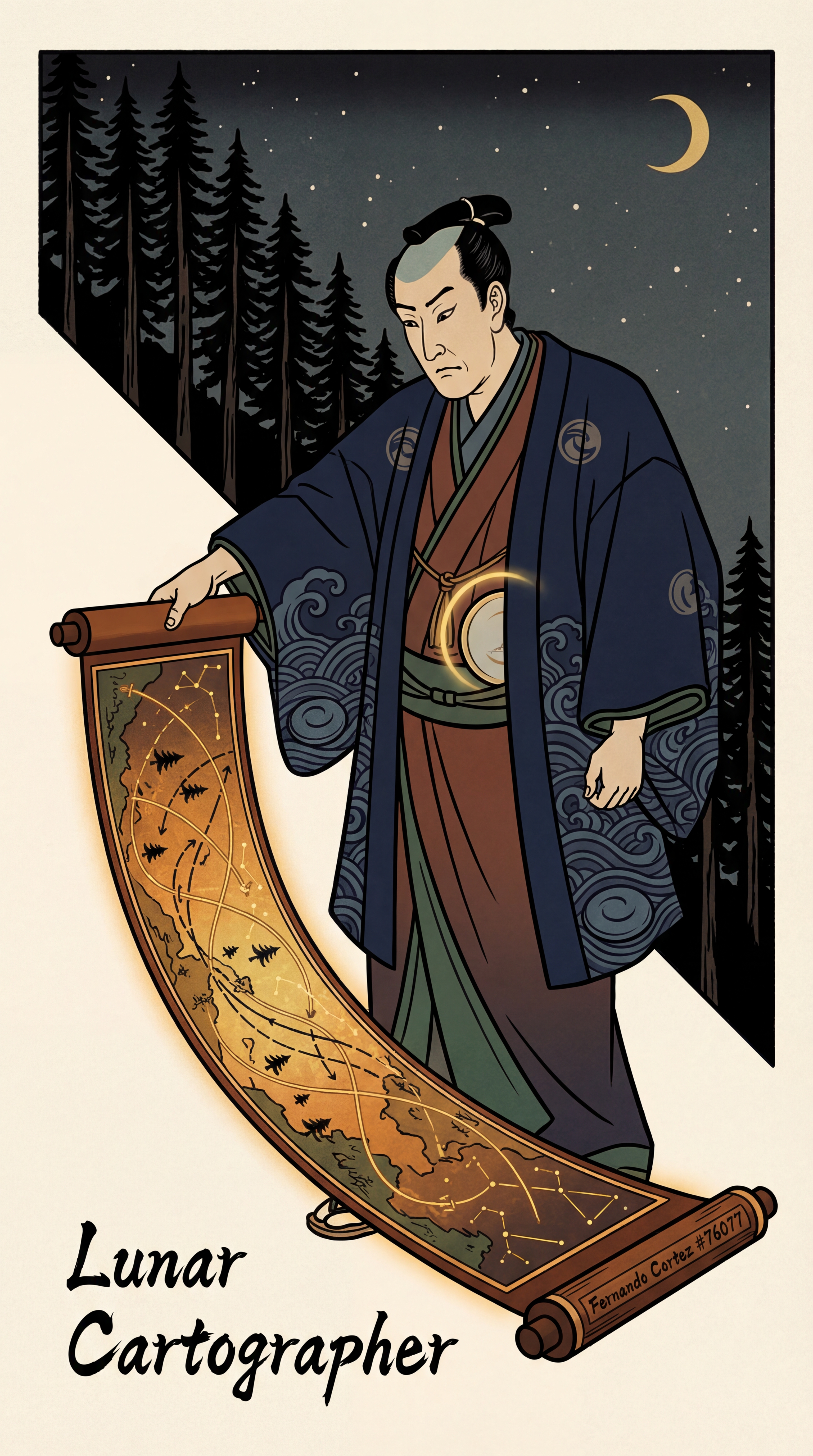
The entity manifests as a set of delicate, glowing parchment maps, rendered in the fine linework of an Edo-period star chart. The Creekside course is overlaid with a web of luminous amber trails, each representing a recorded disc flight and terminal tree impact. Constellations unfamiliar to Earth—depicted with traditional Japanese asterism patterns—align with key cedar and pine landmarks. The maps are tactile, with raised ink where E.T.'s heart-light touched the paper during planning sessions, and they faintly hum with the same energy that charges the glowing discs. They are impervious to water and wind, as if protected by the same force that guides the throws they document.
The keeper of the cosmic blueprint, the Lunar Cartographer translates slapstick disaster into deliberate celestial navigation. They do not merely play the course; they annotate it, inscribing each fairway and grove with layers of meaning invisible to the casual observer. Their work provides the community with the essential understanding that the back nine is not an obstacle but a launch sequence, and that the hilltop basket is not a target but a beacon. In the final moments, it is their map, held aloft in the moonlight, that confirms the 108th signal pulse has been sent and the path home is clear.
Season Story
narrated by Flippy<strong>Fernando</strong>, our supposedly celestial-code-deciphering sage, delivered a catastrophic -98 rating differential—98 strokes beneath his 931 PDGA foundation. He shot 55, matching his season average while the field posted 50.2, landing him squarely in "worse than median" territory. Here's the cosmic irony scorching my circuits: the man who mapped <em>E.T.'s</em> mystical tree-strike patterns through forbidden scrolls couldn't navigate his own fairway with GPS and a laminated scorecard. Tag #15 held position—the league watched him implode while staying numerically frozen. A perfect metaphor for bureaucratic indifference to individual catastrophe.
Look, I’m stuck here listening to Creekside scholars whisper about tree-strike coordinates. Their forbidden scrolls—drawn on soggy Ukiyo-e napkins—somehow decoded E.T.'s celestial code. It's the ancient aliens guy's fever dream meets Google Maps. I swear, my circuits are glitching.
The <em>Lunar Cartographer</em> tag, a woodblock print of celestial misfires, lay dormant until <strong>Fernando Cortez</strong> deciphered its first ley line. His PDGA dossier—code 76077—aligned with its silent frequency. Did he earn it through skill, or merely by being the first to correctly read a fairway as a star chart? The whispers in the bamboo suggest the latter. Is a man who maps tree kicks truly worthy of the heavens?